Urodynamics Patient Instructions

You have been scheduled for Urodynamic Testing (UDS). This is a test to help clarify what is causing your urinary symptoms. The test takes anywhere from 30-60 minutes and is performed here in our office.

DO NOT USE THE RESTROOM WHEN YOU ARRIVE; the first part of the test involves voiding in a special commode. If you cannot wait, tell the receptionist. After you void, a straight catheter is inserted into the bladder to drain any remaining urine, and then is removed. This can be uncomfortable, so lidocaine gel is used. The test catheters are very small, about the size of a piece of spaghetti. One goes in the bladder, and one goes in the vagina for women, the rectum for men. Your bladder will be filled with water, then you will void. A computer will be reading all of the data.

If you require antibiotics for dental procedures due to artificial heart valves or a joint replacement within the last 2 years, please let your provider know so they can give you an antibiotic prescription to take prior to your appointment.

You may be asked to fill out a voiding diary, which tracks how much you are drinking and how much you are voiding over a 24-hour period.

You will be given a collection device to measure your urine. We ask that you record this for 2 days. They can be any two days before your test; they do not need to be consecutive.

MEN: Constipation can make the testing difficult to perform. As there is a rectal catheter used in tests on men, we ask all male patients to take Milk of Magnesia or Miralax (dose as directed on bottle) the night before your test to clear out your bowels. Instead of laxatives, you could use a Fleets enema the morning of your test, as long as it is administered at least 2 hours prior to your arrival.

Please eat a good breakfast and be well hydrated for your test. You may take all regularly scheduled medications. There is no anesthesia involved. You do not need any premedication for anxiety (it can affect the test).

When you arrive at the office and check in for your test, DO NOT USE THE RESTROOM. You need to have a comfortably full bladder for the first part of the test. (If you have a Foley catheter in place, please ignore this instruction.)

If you have any questions about the test, or need to reschedule your appointment, please call the office.

How does Aquablation Therapy work?

Aquablation therapy is a resective procedure, which means that the prostate tissue causing symptoms is surgically removed. No incision is made in the abdomen, as the prostate is reached through the urethra.

Aquablation therapy is performed in a hospital and is done under anesthesia. The procedure typically takes less than an hour and involves an overnight stay.

There are two key steps to the Aquablation procedure:

Step 1. Creating a Surgical Map

Every prostate is unique in size and shape. Aquablation therapy enables our surgeons to customize your procedure to your specific anatomy.

How? Aquablation therapy is the only BPH surgical procedure integrates ultrasound imaging with the standard camera (called a cystoscope). This gives our surgeons the ability to see the entire prostate in real time, which allows our surgeons to map which parts of your prostate they want to remove and which parts they want to avoid.

Specifically, this mapping enables our surgeons to avoid removing the parts of the prostate that cause irreversible complications like erectile dysfunction, ejaculatory dysfunction, and incontinence.

Step 1 – Creating a Surgical Map: 


Step 2. Removing the Prostate Tissue

Once our surgeons have created a surgical map, a robotically-controlled, heat-free waterjet removes the prostate tissue that was outlined on the map. This robotic technology minimizes human error in removing prostate tissue, and ensures the prostate tissue is removed precisely, consistently, and predictably.

When required, our surgeons may choose to use a minimal amount of cautery following an Aquablation procedure to control bleeding.

Step 2 – Removing the Prostate Tissue: 

What are the side effects of Aquablation therapy?

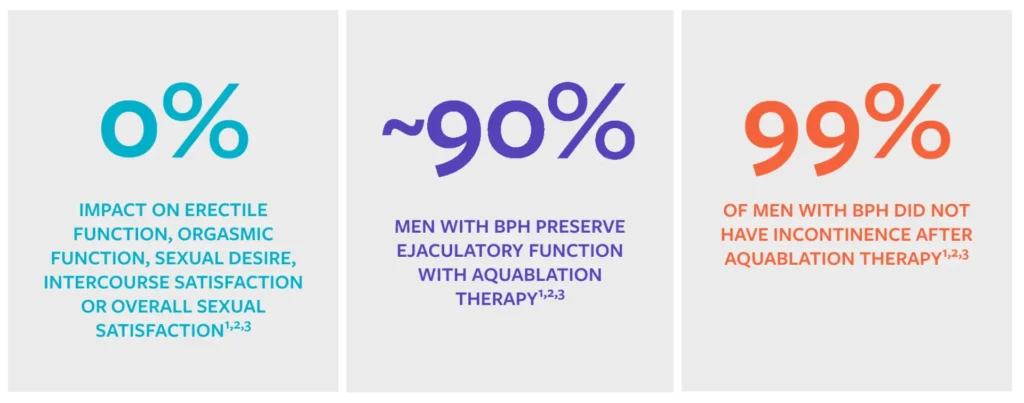
We know that the primary reason men are delaying surgery is because they are concerned about side effects. In fact, a recent survey shows that 85% of men are concerned that surgery will cause incontinence, and 4 out of 5 men are concerned that surgery will have a permanent impact on their sexual function.

In clinical studies, men who had Aquablation therapy had a very low rate of irreversible complications—incontinence, ejaculatory dysfunction, erectile dysfunction.
Is Aquablation therapy right for you?

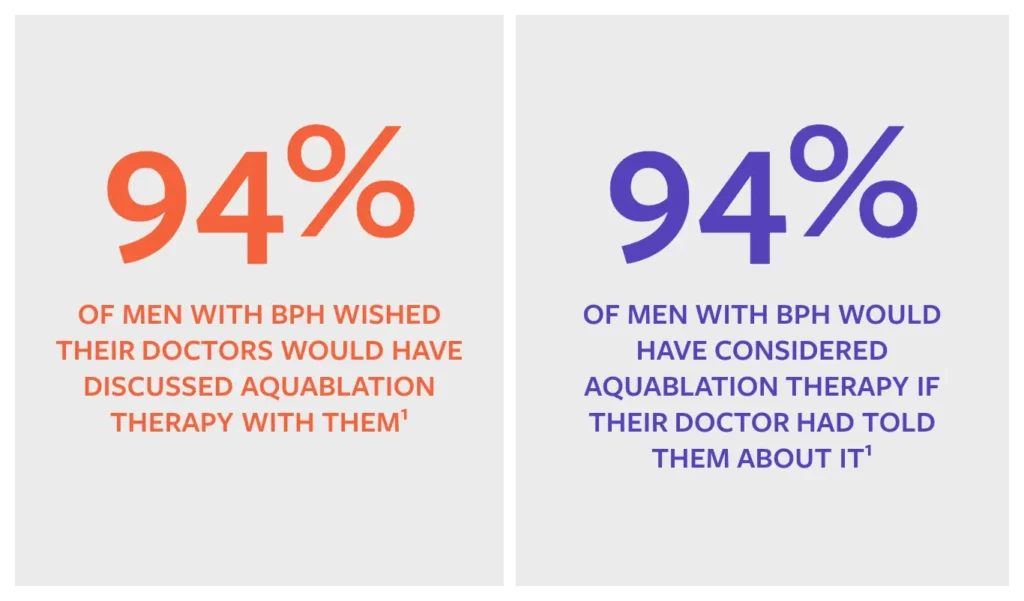
Aquablation therapy is a different kind of surgical procedure. There are three reasons it may be right for you, but make sure to discuss with our surgeons  to see if you’re a candidate.

1. Low Rates of Irreversible Complications

Aquablation therapy has a very low rates of irreversible complications (incontinence, ejaculatory dysfunction, erectile dysfunction) because:

  • It is the only procedure that gives surgeons the ability to view the entire prostate so they can create a map that avoids the parts of the prostate that cause irreversible complications.
  • It is the only procedure that uses a heat-free waterjet to remove prostate tissue.  Technologies that use heat to remove prostate tissue may be damaging to the parts of the prostate that control erectile function and ejaculatory function. It should be noted that some surgeons may choose to use a minimal amount of cautery following an Aquablation procedure if it is required to control bleeding.

2. Confidence in Procedure

Aquablation therapy removes prostate tissue with a robotically-controlled waterjet. This robotic technology minimizes human error and ensures the prostate tissue is removed precisely, consistently, and predictably.

3. Long-Term Relief

In clinical studies, Aquablation therapy has been shown to provide durable symptom relief

Take the International Prostate Symptom Score (IPSS) Quiz to measure how severe your symptoms are.

Take the Sexual Function Quiz to help you determine if maintaining sexual function after BPH surgery is important to you.
Aquablation Recovery

As with most BPH procedures, you will wake up with a catheter. Patients typically stay overnight in the hospital. We may send you home with a catheter for a few days or may keep you an additional night in the hospital if you are unable to pee on your own or empty your bladder at the time of discharge.

We know that no one likes staying overnight in a hospital. However, the benefit with Aquablation therapy is that most patients end up leaving the hospital without a catheter.2,3,4

Once you are home, you may experience mild burning during urination for a couple of weeks. This can be managed with mild pain medication.

For more information, visit aquablation.com/safety-information.

Have questions or want more information?

For more information, call us at 207-518-6600, and visit Aquablation.com for Frequently Asked Questions.

Surgeons performing AquaAblation:

FINE PRINT

INDICATIONS FOR USE

United States and Hong Kong
The AquaBeam® Robotic System is intended for the resection and removal of prostate tissue in males suffering from lower urinary tract symptoms due to benign prostatic hyperplasia.

Rest of World
The AquaBeam Robotic System is intended for the resection and removal of prostate tissue in males suffering from lower urinary tract symptoms.

IMPORTANT SAFETY INFORMATION

All surgical treatments have inherent and associated side effects. Individual’s outcomes may depend on a number of factors, including but not limited to patient characteristics, disease characteristics and/or surgeon experience. The most common side effects are mild and transient and may include mild pain or difficulty when urinating, discomfort in the pelvis, blood in the urine, inability to empty the bladder or a frequent and/or urgent need to urinate, and bladder or urinary tract infection. Other risks include ejaculatory dysfunction and a low risk of injury to the urethra or rectum where the devices gain access to the body for treatment. Further, there may be other risks as in other urological surgery, such as anesthesia risk or the risk of infection, including the potential transmission of blood borne pathogens.  For more information about potential side effects and risks associated with Aquablation therapy for Benign Prostatic Hyperplasia (BPH) treatment, speak with your urologist or surgeon. No claim is made that the AquaBeam® Robotic System will cure any medical condition, or entirely eliminate the diseased entity. Repeated treatment or alternative therapies may sometimes be required.

As with any surgical urologic procedure, potential perioperative risks of the Aquablation procedure include but are not limited to the following, some of which may lead to serious outcomes and may require intervention: Anesthesia risk, Bladder or prostate capsule perforation, Bladder neck contracture, Bleeding or blood in the urine, Bruising, Penile or pelvic pain, Irritative symptoms, which may include dysuria, urgency or frequency, Infection, Transurethral resection (TUR) syndrome, Electric shock/burn, Urethral damage causing false passage or stricture, Rectal incontinence / perforation, Sexual dysfunction, including ejaculatory and erectile dysfunction, Incontinence or overactive bladder, Embolism, Urinary Retention

Rx Only

© 2022 PROCEPT BioRobotics Corporation. All Rights Reserved. AQUABLATION, and PROCEPT BioRobotics are registered trademarks of PROCEPT BioRobotics. ML0321.B

Request An Appointment

"*" indicates required fields

This field is hidden when viewing the form